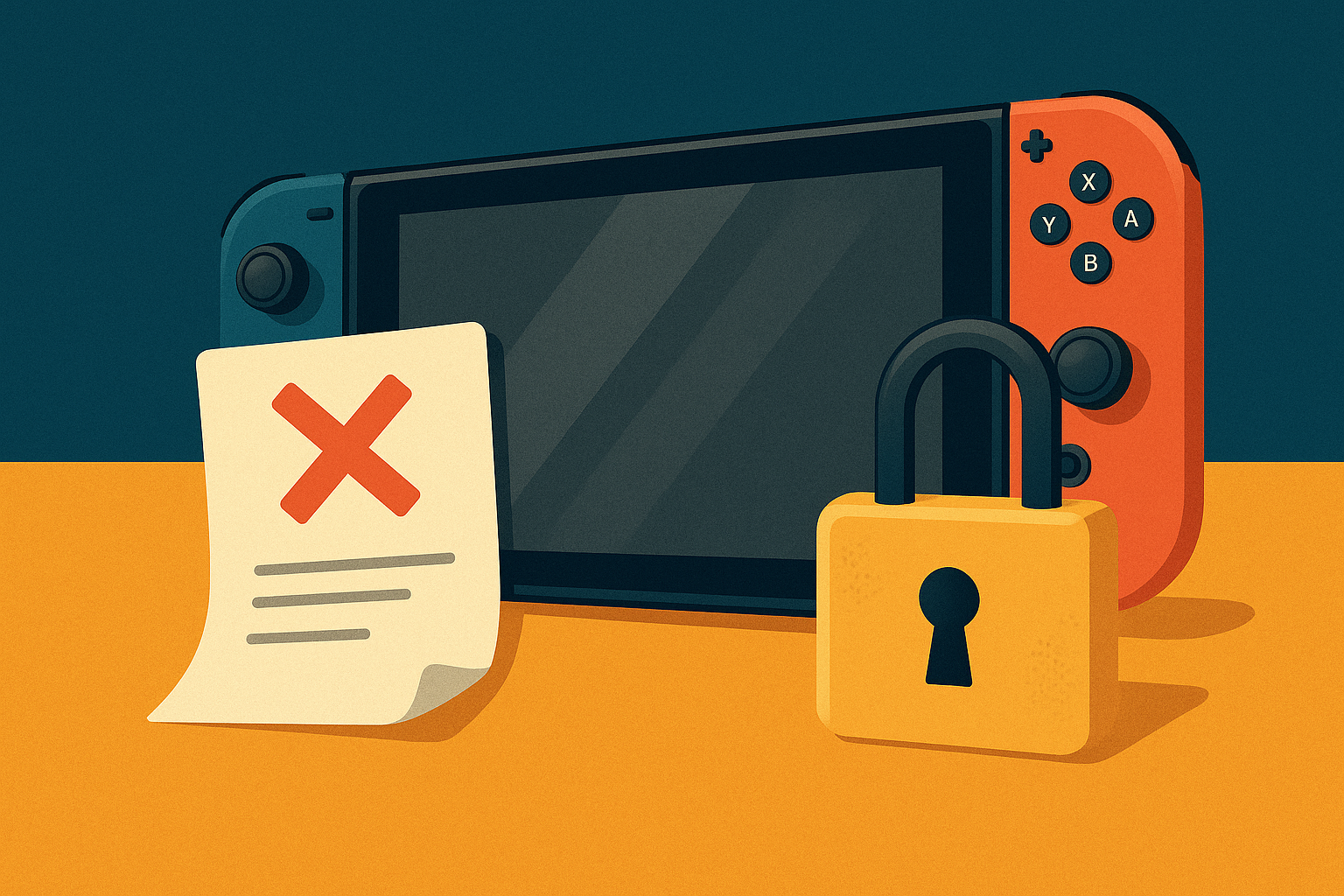
Nintendo’s Switch 2 launched in June 2025 with fanfare, new features—and one clause in its user agreement that raised eyebrows. If you tamper with your console or break Nintendo’s rules, the company reserves the right to make the device “permanently unusable in whole or in part.” In other words, they can remotely brick it.
It’s not just about banning you from online services. Nintendo is claiming the right to disable the console itself if you step outside the lines. In Europe, consumer laws prevent this kind of device-killing penalty (MeriStation), but in North America the clause stands. That means Canadian buyers now own a Switch 2 on Nintendo’s terms—not fully on theirs.
This kind of clause has become surprisingly common. We’ve seen it before, and not just in gaming.
When “Buy” Means “Borrow”
Sony made headlines in 2022 when it removed hundreds of StudioCanal movies from PlayStation users’ libraries in Germany and Austria. Customers who had purchased films like The Hunger Games or Paddington woke up to find them gone, thanks to expired licensing agreements. In 2023, Sony announced a similar purge of Discovery Channel content—again, shows people had “bought.” After public outcry, that removal was partially reversed, but the lesson was clear: when you buy digital media, your access depends on the company’s contracts, not your wallet.
Amazon pulled a similar stunt years earlier. In 2009, it remotely deleted George Orwell’s 1984 and Animal Farm from Kindles due to rights disputes (WIRED). The irony wasn’t lost on readers. Even Microsoft joined the parade, shutting down its eBook store in 2019 and deleting every customer’s purchased library—offering refunds, but leaving buyers with nothing to actually read.
Cars and tractors aren’t immune either. Tesla has removed Autopilot and Full Self-Driving from used cars after resale, deciding the features didn’t “carry over” even though the hardware was in the car. And the U.S. Federal Trade Commission is suing John Deere for allegedly monopolizing tractor repairs by locking machines behind software restrictions (FTC press release).
From video games to farm equipment, the message is consistent: you may pay for the product, but the company still holds the keys.
Why This Matters for Estate Planning
As estate planners, we’re trained to help clients think about what they own, how to protect it, and how to pass it on. Traditionally, that meant homes, investments, businesses, art, even cars. But in a world where much of what we “own” is digital or software-enabled, we need to ask harder questions.
When a client tells you they have a library of movies on PlayStation or Amazon Prime Video, they don’t truly own transferable property. They have a revocable license. That means when they pass away, those movies may not be accessible—or even exist—by the time heirs try to watch them. The same goes for eBooks, software subscriptions, music tied to streaming platforms, and increasingly, cars and devices with digital add-ons.
Even hardware isn’t immune. Imagine leaving a Switch 2 to your child in your Will, only for them to find that Nintendo can disable it if they try to modify it or even use it in ways Nintendo doesn’t like. In practical terms, you may be leaving them a device that only works as long as the vendor permits.
This complicates planning in two ways:
- Valuation. How do we value digital “assets” that might disappear with a licensing change? Is a movie library worth anything if it can vanish overnight?
- Transferability. Many digital goods are tied to personal accounts and can’t legally be transferred. Even where platforms allow account succession—like Apple’s Legacy Contact or Google’s Inactive Account Manager—they only cover some data, not purchased content licenses.
What Advisors and Clients Can Do
For now, the best approach is education and preparation:
- Set expectations. Remind clients that digital libraries are often licenses, not assets. They may not survive them.
- Prioritize the transferable. Encourage clients to keep critical data, media, or records in formats they can control offline.
- Document features. For digital add-ons (like Tesla’s Autopilot), keep records of what was paid for and what’s included. This matters for both resale and estate valuation.
- Plan for accounts. Use tools like Apple’s Legacy Contact and Google’s Inactive Account Manager to ensure at least access to data and communications.
- Think about alternatives. Sometimes, buying the disc, book, or physical copy is the only way to ensure lasting ownership.
Ownership in Name Only
Nintendo’s blunt EULA is just the latest reminder of how fragile ownership has become. Whether it’s a console, a car, or a movie library, more and more of what we “own” is conditional. For estate planners, that means adapting: not everything a client believes is an asset will behave like one.
It also means asking the right question up front. When a client says, “I own this,” what they may really mean is, “I have access—until someone else decides otherwise.” In our work, drawing that line clearly may be just as important as writing the Will itself.