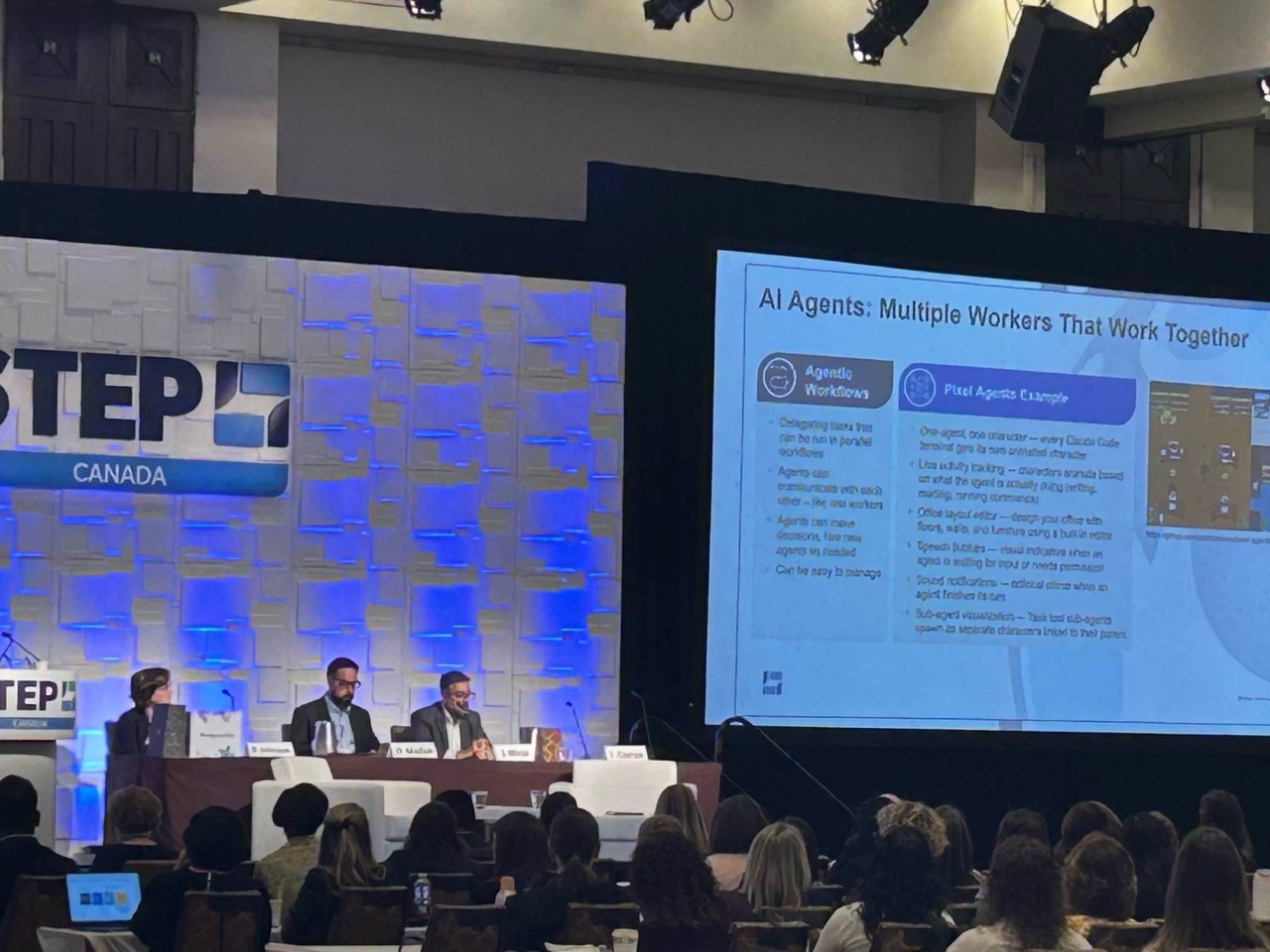
This week I had the privilege of co-presenting the opening plenary for day 2 at the STEP Canada National Conference in Toronto. I shared the stage with Junaid Mirza from PwC Canada, with Rhonda Johnson keeping us on track as moderator. Our session, “Intelligent Counsel: Harnessing AI for the Future of Estate and Tax Practice,” tried to do something a little different.
Most AI talks live entirely in the abstract. Big claims about disruption, a few unsettling charts, the obligatory robot photo. We skipped all of that. Instead we put a real trust deed up on the screen and showed the room exactly what AI does with it, live. No theory, no hand-waving. For everyone who asked for a recap afterward, and for those who weren’t in the room, here is the short version.
The reason most of us walked away
Think back to late 2022. ChatGPT lands, and overnight everyone is convinced AI is about to rewrite legal practice. A few firms jumped in early. A lot of practitioners experimented for an afternoon and then quietly closed the tab.
Honestly, they had good reason to. The early models hallucinated constantly. They were confidently wrong, which is the worst kind of wrong. They had no real grasp of context, and if you fed them junk you got junk back. So most people reasonably decided the technology wasn’t ready for serious work.
Here was our message to that room. If that was your experience, you weren’t wrong. You were just early.
What actually changed
Three things, really.
First, the models now understand structure and context. They know what a vesting clause is and what a beneficiary designation does. That sounds small. It isn’t.
Second, and this is the big one, you can now hand the tool the actual document. Not a question about the document. The whole hundred-page trust deed goes in.
Third, the quality of what you ask for drives the quality of what you get back. Prompting is a real, learnable skill, and it’s the difference between a generic answer and one you can actually use.
Hallucinations still happen. They are just far less frequent when you work the right way.
The part where I stopped talking and started showing
We ran a fictional but realistic trust, the Morrison Family Trust. A settlor, a corporate and an individual trustee, shares of a private holding company, multiple classes of beneficiaries, fully discretionary distributions, a 21-year vesting date. Plenty going on.
My first prompt was plain English: read this deed and give me structured practitioner notes covering parties, trust property, beneficiaries, distributions, trustee powers, and vesting. I attached the PDF and let it run.
Seconds later it came back with clean, organized notes. It picked up the share classes and drilled into what the holding company actually owns, right down to the $2.4 million promissory note. It sorted the beneficiaries into primary, secondary, and excluded, and it correctly flagged that the settlor and any non-residents are shut out. Then it did something that made the room sit up. On its own, it noted that the section 104(4) deemed disposition would apply on the vesting date. Nobody asked it to. It connected a fact buried in the document to a tax consequence we would all want flagged. That is not summarizing anymore. That is the beginning of reasoning.
Good notes are still not something you put in front of a client, though. So my second prompt asked for a polished, plain-language slide for a client meeting, written for people who are not lawyers. Seconds later, there it was. The same dense legal document, now readable by a family member, complete with a gentle note that Robert cannot receive from the trust and a heads-up about the 2039 wind-up.
Two prompts. Under a minute. The blank-page problem, gone. You still review it for accuracy, tweak the firm name, maybe soften a line. But you are now spending your time with the client instead of wrestling with PowerPoint.
Where it works, and where it still needs you
This is the part that matters more than the demo, and Junaid framed it well. AI is genuinely excellent at summarizing complex documents, getting a first draft on the page, translating jargon into plain language, and accelerating research. Treat that first draft the way you would treat work from a capable junior. Useful, but never final.
What it cannot do is carry your professional judgment, your duty of confidentiality, or your relationship with a client. Every output needs verification. Hallucinations have changed shape rather than disappeared. The tools are less likely to invent case law now and more likely to hand you a quotation that doesn’t quite exist. And the line between enterprise tools and personal ones is not a footnote, it is a governance requirement.
Where this is going
We are already moving from AI that answers one question at a time to agents that carry out multi-step work on their own. “Review this estate file and flag every compliance issue” stops being a conversation and becomes a task you hand off. Our role shifts from doing the work to directing and verifying it.
If you have been waiting for the right moment, the advice we left the room with was simple. Crawl, then walk, then run. Start this week with something low stakes. Use it as a sparring partner on a draft you have already written and ask what you missed. The barrier to entry is genuinely low. The learning curve is real but worth it.
The honest headline is this. What we demonstrated on that stage was state of the art maybe a year ago. Today it is table stakes, and the technology gets more capable almost every month. What it will not replace is your judgment and your ability to sit across from a family and explain what their plan actually means. Use these tools to claw back time from the menial work, then spend that time where it counts.
If you were in the room, thank you. If you have questions, or you just want to compare notes on what you are trying, reach out. I am always happy to talk it through.