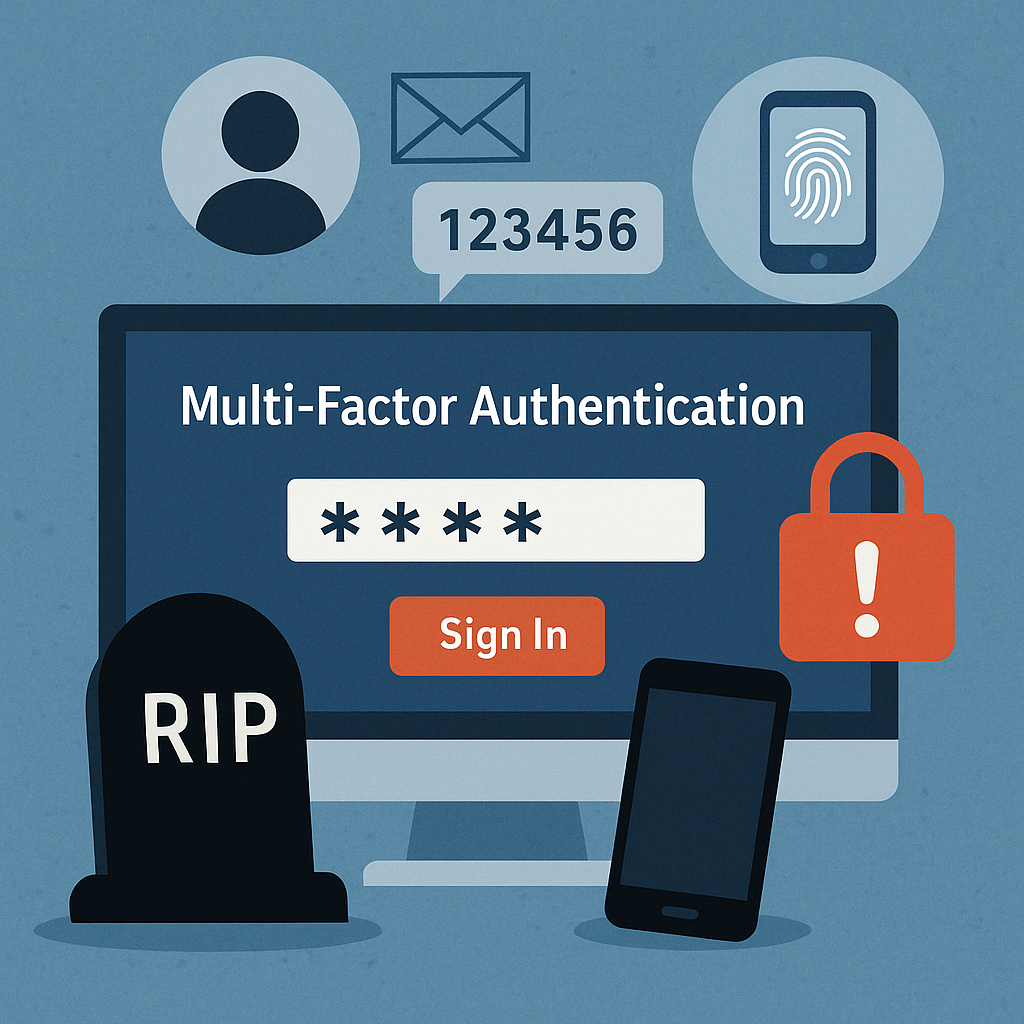
Estate professionals still talk about passwords as if they are the primary barrier to digital assets. They aren’t. The real barrier today is something far more common and far more destructive to modern estates: multi-factor authentication.
Over the last few years, most major platforms have tightened their security models. Apple, Google, Microsoft, Steam, crypto exchanges, cloud services and even banks now rely on trusted devices, biometric confirmation and time-sensitive authentication prompts. This is excellent protection while someone is alive. It becomes a serious obstacle the moment they are gone.
Families often assume an executor “just needs the password.” In reality, the password is only the first step. The second step is where everything breaks down.
A login prompt appears on the deceased person’s phone.
A verification code is sent to a number that has already been cancelled.
A biometric scan is required, but no one can unlock the device.
An authenticator app sits on a phone that no one can access or restore.
When the person dies, the entire verification chain often dies with them.
This is what I refer to as authentication fragility. A digital estate doesn’t fail because the family can’t find passwords. It fails because access depends on a single device or identity that no longer exists. The system is doing exactly what it was designed to do: reject any login attempt it cannot validate.
Executors frequently know the credentials and still can’t get in. In many cases, even a death certificate is not enough to override modern verification rules. Some companies simply do not offer a recovery path if multi-factor authentication cannot be completed.
The consequences are wide-ranging. Cloud photos become permanently inaccessible. Email accounts lock out the executor entirely. Financial and investment platforms refuse access. Crypto assets and gaming inventories remain stuck behind authentication prompts that no one can approve. From the outside it looks like a simple login problem. In reality, it is a modern security system preventing digital theft — and unintentionally blocking legitimate estate administration.
The estate industry has not fully caught up to this reality. Traditional estate planning focuses on wills, taxes, liquidity and distribution, but it rarely addresses the practical question that now governs every digital asset: How will the executor authenticate into the accounts when the user is no longer alive to approve the login?
Families can reduce the risk of permanent lockouts with a few simple habits:
• Add a second trusted device whenever a platform allows it. One backup device can stop an estate from collapsing.
• Save recovery codes. Many platforms generate one-time backup codes, but most people never store them.
• Avoid relying on a single authenticator app on one device. If that device is wiped or lost, access disappears with it.
• Ensure biometrics are not the only way to unlock a device. There must always be a passcode fallback.
• Document which accounts rely on specific devices, phone numbers or authentication methods.
These steps may look small, but they dramatically reduce the chance of losing access forever.
Digital wealth now encompasses far more than cryptocurrency. It includes photographs, documents, subscription services, cloud storage, online businesses, financial tools, gaming inventories and marketplace balances. All of these depend on authentication systems that are becoming stricter each year. If the authentication chain breaks, the transition of those assets breaks with it.
Executors cannot administer what they cannot access. Beneficiaries cannot receive what is locked behind a verification prompt that no one can approve.
This is the part of digital estate planning that families and advisors need to confront directly. MFA is not going away. The security around digital life will only continue to tighten. And unless people prepare for the authentication problem, more digital wealth will quietly vanish, not because it lost value, but because no one could get through the second step.